
The Village
by Leopold Lindtberg, 1953
World War II orphans are welcomed into a children's village in the Swiss Alps. Over 200 children from all over Europe are brought together in a joyful mix of languages and cultures. But on arrival, the German children are seen as symbols of oppression rather than victims by their peers from other countries. And just as a love story is unfolding between two teachers, a British man and a Polish woman, Communist Poland decides to leave the experiment... The Cold War is upon us. The end credits pay tribute to the teachers and children of the Pestalozzi Village in Trogen, from which the story is inspired and where the film was partly shot.
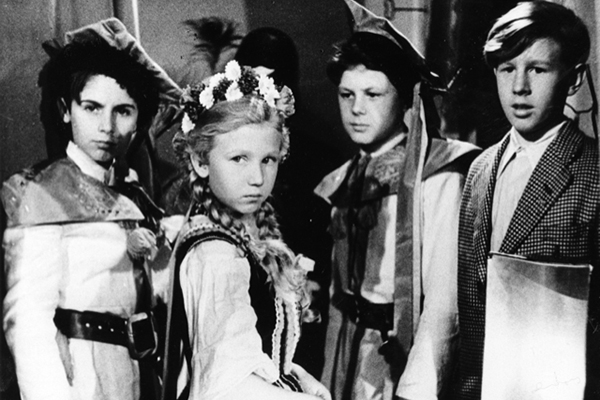
Leopold Lindtberg's latest feature film for Praesens Films, The Village has a humanitarian message, promoting peace between nations. Like other collaborations between the filmmaker and the Swiss production company (Die letzte Chance or Die Vier im Jeep), the film is a polyglot production: the performers come from ten different countries, and the shooting, which takes place mainly in English and German, also includes scenes in French, Polish and Italian.
The Village by Leopold Lindtberg
1953, 93 min, Switzerland / UK
Film with Lumière Classics label
Rights owner:
Praesens Films
Project holder:
Frédéric Maire (Swiss Film Archive)
Information on the restoration:
Restoration date: 2023
Laboratory who carried out the restoration: L'immagine ritrovata, Bologna
Restoration: Cinémathèque suisse with the collaboration of Memoriav and SRF
4K image digitization and restoration: Laboratoire Cinegrell, Zurich
Sound restoration: Tonstudio Z, Zurich
The film has been restored from image and sound negatives deposited by Praesens Films at the Cinémathèque suisse. This is the international version of the film, as it was presented at Cannes in 1953 and broadcast worldwide, in France under the title Le village près du ciel.
There is a slightly shorter "Swiss" version with more Swiss German dialogue, entitled Unser Dorf, with different negatives.
Two different versions for Germany and Austria were released, with the titles Sie fanden eine Heimat and Kinder in Gottes Hand.
Rights available:
Worldwide, except Switzerland