Charlotte Barker: “Our major challenge is getting the films that we've restored to be released."
Charlotte Barker (Senior Director, Film Restoration and Preservation, Paramount Pictures).
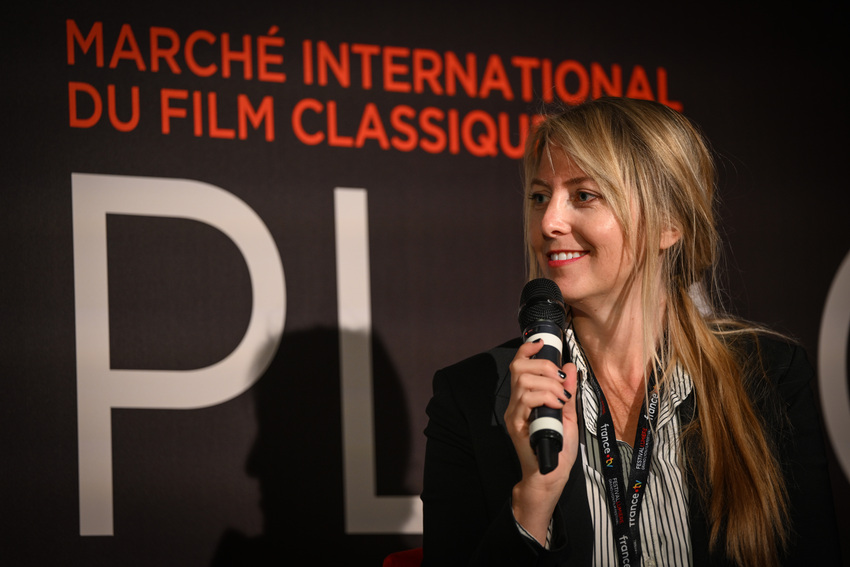
Why was it important for you to be present at the International Classic Film Market?
I love being at these markets just to be able to talk to people about classic films and to meet people and to talk about classic movies. For me, it's fun to be around people who love classic films and classic cinema. It makes me excited to do my job just to talk to people who are so excited about it. Because in Hollywood, a lot of people are more interested in new films, so it's nice to be around people who are more interested in old films.
It’s very clear how passionate you are about classic films. Since you are working essentially with old movies, what's your relationship to new releases?
I find myself watching a lot more of old films, just because it’s my job, but I watch the new ones too. I go to new movies all the time too. I just love movies. I find it hard to distinguish work and not work sometimes, just because what I love so much is movies.
In your opinion, what is the major challenge that the industry is facing right now?
For me, it's getting the films that we've restored to be released. That's the major challenge for us, and it usually has to do with rights. It can be music rights or any other kind of rights, or maybe it's just having enough people at the studio to check the rights. It's really just getting the films out there after they've been restored; that’s the biggest challenge for me. We don't have a dedicated person just trying to do that in our team, but that would be nice. So it's left up to me to do that whenever I can.
Paramount has a very large catalog, which includes old and new movies. Listening to you, we can think that old movies are a huge part of Paramount's catalog. In reality, what is its part in Paramount’s catalog?
It’s a huge part of the catalog. We own not only the Paramount catalog, but we also have Republic Pictures. We own all of their films. We have over four thousand shorts; we have short films and two reel musicals, we have animated films. So our catalog of older titles is really vast. And just when you think that we would have worked on all of them, you look at how many we have left, and there are still so many. So it's a huge part of our catalog.
You’re very active on Instagram, and you’re also on YouTube. Why was it important to showcase your work on these platforms today? You explain that it was to address the negative comments people were posting about Paramount online. Is it also to reach younger generations—who use these platforms—in order to introduce them to classic films?
Well, it's a bit of both. It's to show people what we're doing and to show that there are real people who care about the catalog there. It's not just a bunch of bean counters, which usually is what you hear people refer to on the film forums. I also just love what I do, and I know that there are other people who get excited about the little things that we find. I would post things for friends on my Instagram account, which was private for a long time, and then I had someone say: "You should really make this public. People would find this interesting." So that's what I decided to do. But again, I think that the best way to respond to negative comments is not to be defensive but to show people that it actually isn't that way, to be positive about it and to show people that there are people that care about this stuff. And also it's a good way to teach people stuff too. So I use it as a learning platform where I can show people a negative that's faded and how we deal with color fade. “Hey look, here's how we identify a color fade", or "here are two prints that we're looking at to figure out what the best way to preserve the color is or what the color should look like when we're restoring something," and "What print do you think we're going to choose?” I just try to bring people along on the restoration journey.
You started getting interested in restoration work as a teenager. Do you feel that through your Instagram account you have brought teenagers and young people to the restoration field? Not just to classic films, but really to the idea of working in restoration?
Yeah. People message me all the time and ask me how to get into the field. I've met with people before who are interested in it and ask me for advice all the time. It happens a lot, so I know that I am reaching people and that they are inspired, which is kind of crazy to me, thinking that kind of stuff would inspire people because I still feel inspired by other people, so it's weird that people would be inspired by me. But I always try to pay it forward, as they say, because so many people helped me out and gave me advice that really helped me. I try to do the same to others.
During your intervention at the market, you said that the audio work on Sunset Boulevard was « AI done well. » Do you have an example of AI done bad?
We think that restoration should be about removing things that shouldn't be there, and I would think AI would be adding things that shouldn't be there, right? But that's something that we don't want to do. Also, we try to think of how we could use something as a tool rather than replacing anybody.
The International Classic Film Market is made possible by
 |
 |
 |
 |
|
In partnership with |
With the support of |





Media Partners