Cinema heritage: what are the environmental challenges?
On the occasion of the Lumière Festival 2026, Charles Jaeger (eco-production coordinator at Écoprod) hosted a workshop dedicated to the specific environmental challenges of heritage films and restoration. While valuing existing works is inherently a virtuous approach, the workshop reminded attendees that industry infrastructures and digital technologies weigh heavily on the ecological balance.
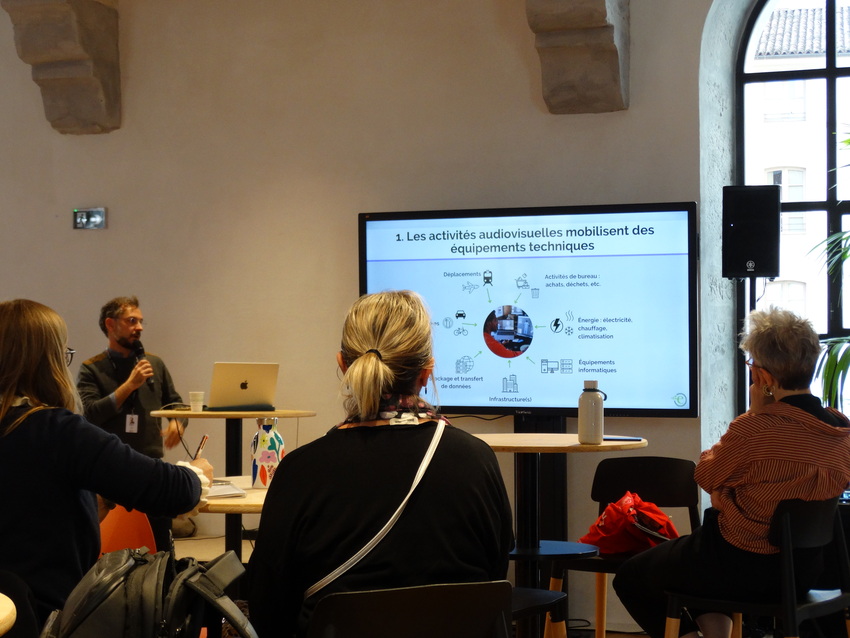
A Sector Under Influence: Measuring to Act Better The audiovisual industry impacts the environment through a multitude of items: the mobilization of technical equipment, travel, catering, office management, and infrastructure energy. To objectify these impacts, the Carbon' Clap tool—approved by the CNC—provides a precise overview by genre.
In terms of carbon intensity, feature-length fiction clearly dominates with an average of 2.67 tCO2e per minute produced, followed by single TV fiction (1.19 tCO2e) and fiction series (0.58 tCO2e). Faced with these volumes, eco-production is no longer limited to live shooting: it encompasses the entire life cycle of equipment (from mining extraction to recycling) and is now finding its way to the heart of film conservation and restoration professions.
The Invisible Trap of Data and Storage
For heritage film stakeholders, the management of digital flows and archiving represents a critical post. As the workshop recalled: "The most eco-responsible data is the data we don't produce."
The life-cycle analysis of storage media reveals striking disparities:
- At manufacturing: An SSD proves to be 8 times more impactful than a hard disk drive (HDD) and up to 140 times more than an LTO tape for the same amount of stored data.
- In use: Conversely, the SSD proves to be twice as efficient as LTO tape in terms of energy efficiency (0.5 W/TB compared to 1.1 W/TB).
To counter volume inflation and the rebound effect, organizations are adopting data tiering strategies (hot, warm, or cold storage), thin provisioning, and infrastructure sharing among rights holders, sometimes making it possible to reduce stored volumes by two-thirds.
Energy Sobriety and AI: The Great Awakening of Studios
On the physical infrastructure side (studios, laboratories, mixing stages), energy consumption traceability (via smart plugs or task-based measurements) is becoming the norm. Practical case studies conducted in mixing stages have thus demonstrated that turning off consoles and projectors during the lunch break generates a 30% energy saving, while taking care not to turn off amplifiers to preserve acoustic quality.
The workshop also shed a harsh light on the emergence of artificial intelligence in production and archiving pipelines. While AI offers valuable levers for indexing, deduplication, and metadata management, its energy cost (learning and usage phases) and multidimensional impacts (water, resources, ecotoxicity) raise questions. For Charles Jaeger and the Écoprod network, the challenge is to structure a strict governance framework: favoring sober models, retaining control over data, and systematically questioning the tool's real added value in the face of planetary boundaries.
The International Classic Film Market is made possible by
 |
 |
 |
 |
|
In partnership with |
With the support of |





Media Partners