Greek Film Heritage: The Internationalization of a National Catalog
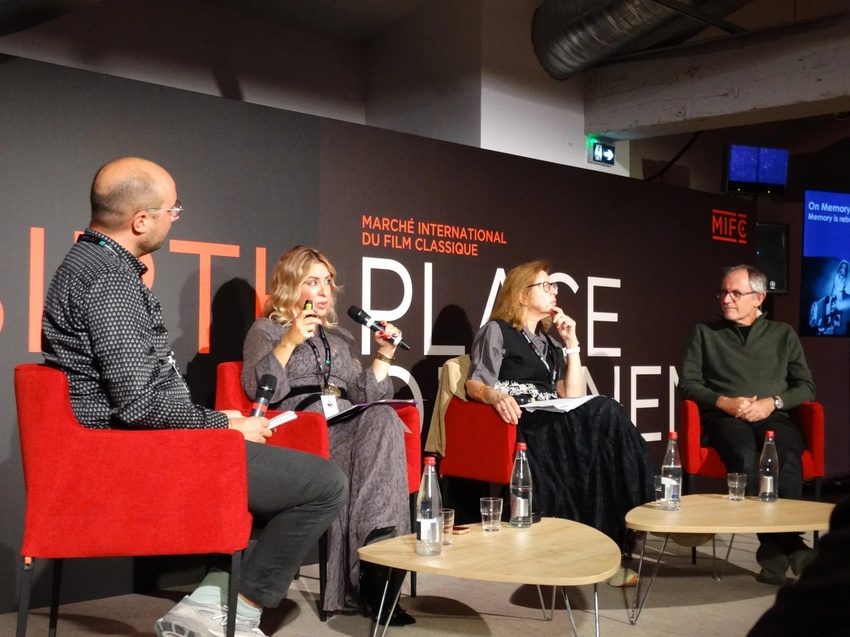
With the 2026 edition of the International Classic Film Market featuring two countries and territories in the spotlight, the first day of the Market was marked by the roundtable discussion “Bringing Greek Film Heritage to Life: What Models for the Future?” Bringing together Irini Andriopoulou, Director of Film Education and Heritage at the Hellenic Film & Audiovisual Center (EKKOMED); Philippe Chevassu, Founder and President of Tamasa Distribution; Maria Komninos, Professor and Chair of the Board of Directors of the Greek Film Archive, and moderated by Aimé Besson, Audiovisual Attaché at the Institut Français in Greece, this roundtable provided a broad overview of the state of Greek film heritage, including its preservation, restoration, and distribution both in Greece and internationally.
Several Different Institutions
Founded in the 1950s, the Greek Film Archive houses a collection of over 900 negatives drawn from the heart of Greece’s rich cinematic heritage, now preserved in the archives. Since 1953, it has been a member of the Association of European Film Archives and collaborates with various foreign institutions to secure funding and make Greece’s film heritage more accessible.
At the same time, EKKOMED, which operates under the Ministry of Culture, aims to support the film industry by creating a positive ecosystem for the visual arts while also launching a visual communication campaign. Balancing its heritage and educational missions, EKKOMED seeks to rebuild an institutional memory—at the intersection of individual and collective memory—to create a hybrid memory that is passed on to the next generation.
New Initiatives
Working toward similar goals, the Greek Film Archive and EKKOMED have both launched new initiatives. For one thing, the Greek Film Archive has begun digitizing several films—a crucial effort as the industry transitions from film to digital. Launched thanks to funding from sources including L’Immagine Ritrovata, this project has made it possible to screen several films from the Greek New Wave in Bologna, such as Robert Manthoulis’s Prosopo Me Prosopo. In addition, the Greek Film Archive has been able to establish its own independent restoration laboratory, in order to secure and utilize European funding and provide a framework for the archives. Although not yet included in Greek national policies, it is expected to be incorporated in the future.
Simultaneously, EKKOMED has launched an online catalog of more than 1,000 accessible films. Through this catalog, it will be possible to contact the rights holders of the available titles and use them at festivals or in theaters. With this initiative, EKKOMED hopes to highlight the Greek catalog within the country—and beyond.
An International Funding Ecosystem
In addition to these two Greek institutions, Greece’s cinematic heritage receives support from several foreign entities, notably through the Association of European Film Archives, as well as through the partnership between the INA and EKKOMED. Foreign distributors also play a major role in Greek classic cinema, particularly Tamasa, even though not all Greek filmographies enjoy the same level of popularity with audiences. Distributing the works of Níkos Koúndouros, for example, is very complicated in France, as their restoration is extremely costly, with little hope of a return on investment in the end. Even though he is a major filmmaker in Greece’s cinematic heritage, it is unlikely that his films will ever be screened again in France under good conditions.
The Need for National Funding
The issue of funding remains a major concern in Greece, where national policy has struggled to incorporate traditional cinema. At a time when most of the Greek Film Archive’s funding comes from foreign entities, the need for a national heritage policy is paramount. EKKOMED, for its part, states that a national budget will be allocated to it in 2027 to support its archives. However, genuine support from the government is necessary for Greece’s film heritage to continue to exist.
The International Classic Film Market is made possible by
 |
 |
 |
 |
|
In partnership with |
With the support of |





Media Partners