Madeleine Probst and Koen Van Daele: "Showing heritage film can also be an act of resistance"
Madeleine Probst (Head of Programming, Watershed), Koen Van Daele (Deputy Director and Head of Programming, Kinodvor).
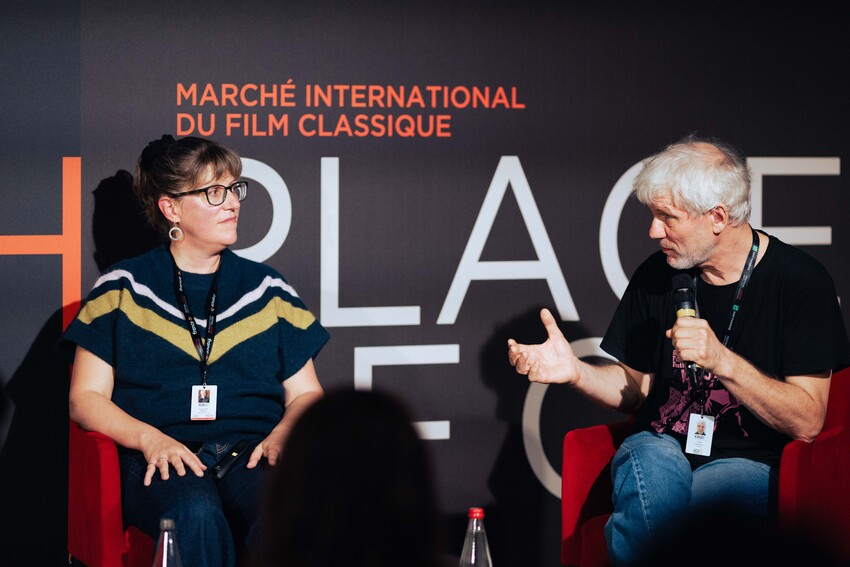
Why was it important for you to be at MIFC this year?
Madeleine Probst: We at Watershed were planning to come anyway. We were encouraged by our partner, Park Circus, to explore the market with the goal of developing the "market" strand of our Cinema Rediscovered festival. We intended to come, and on top of that, we had already been here about a decade ago with a really great experience. So we were there to watch films and find inspiration. When the invitation arrived, I was at a meeting in Berlin, and the stars aligned when Gérald asked if I could take part in this session. It was fantastic for us because we were planning to come anyway, and the opportunity for exhibition to have a platform within a market primarily focused on sales agents is important. I firmly believe that everything starts with the cinema, because we are very close to the audience, so being part of the discussion is paramount.
Koen Van Daele: I’ve known the festival for a long time and have been curious about it for a long time. It was only because I was tied up—not out of a lack of interest, but because it’s normally a super busy period. October is extremely intense. However, when I received the invitation, I thought it was really great that, as Madeleine already pointed out, exhibitors are part of these kinds of events. Very often, production and sales take center stage with many markets and exchanges, while exhibitors are normally relegated to the periphery.
Madeleine Probst: It was a real pleasure to be able to share a platform with Koen, whom I met through the Europa Cinemas network.
Can you actually say a bit more about the importance of the Europa Cinemas network and the CICAE?
Madeleine Probst: When running a cinema, you can find yourself a bit isolated in your own thinking, feeling like a caged lion. Obviously, national networks really help. We have the Film Audience Network in the UK, supported by the BFI, but getting that international perspective really helps re-energize your work and give you fresh inspiration. To be quite frank, we found inspiration in places like the Lumière Festival or Cinema Ritrovato, because there is more cultural investment in those places and an ambition that drew us in. It gave us the courage to create Cinema Rediscovered 10 years ago, which was seen as madness at the time. People thought we were crazy to do a festival of old films, when we are known for events like Encounters, which focus on new talent. It was a big departure for us, and even within the Watershed organization, we had to take the time to convince people. We have seen an increase in admissions for heritage films specifically, going from around 5% before Covid to 14% for 2025–2026. It has become a very important part of the mix that has re-energized this part of the market for us, becoming a revenue generator at a quiet time of the year, right in the middle of July. While we don't show the big summer blockbusters at Watershed, we show Chantal Akerman's films, for example. I looked at the figures: we had 100 people to see Claude Chabrol's Unfaithful Wife at Watershed. Screened at Cinema Rediscovered, the festival created a buzz around the film, allowing it to be shown in some 40 cinemas across the UK as well. The networks really helped give us that level of admissions.
And from Slovenia's perspective?
Koen Van Daele: It's more or less the same. In the cinema sector, it is very important—and always forgotten by production and distribution—to think about the localization of films, where they are screened. But beyond localization, there are many subjects, issues, and practical information addressed in these international networks. We sometimes think that problems are unique to us, that this can only happen in Ljubljana, but in fact, it happens in Madrid, Bristol, or elsewhere, and talking allows us to find solutions together. Cinema is about people as much as films, and you have to pay equal attention to both.
Madeleine Probst: You also have to think about experience design. Our bar-café is the beating heart, because it’s there before and after screenings. Unlike in France, a cinema cannot just be a dark room; that’s not enough. You have to think about wine, the experiences created, and increasingly, where people discover films. Furthermore, Letterboxd in the UK has been a real regenerator for repertory films, as people discover works through this platform. They create lists; it's incredible. We screened Edward Yang's Yi Yi as part of a small program on Taiwanese cinema without high expectations at first, back when Letterboxd was starting out. Our largest screen sold out instantly. A young staff member explained to us that the film was on Letterboxd's list of the 10 films to see before turning 30. We understood the importance of this and we use it as a tool, to check and share reviews with the public so they see we are aware of what's happening.
Koen Van Daele: We also created boards where people can give their opinions on films or other things, which are displayed on the wall. My staff were extremely reluctant at first, thinking it would never work in Ljubljana, that people are shy and don't want to write anything or expose themselves. And with phones and social media, you wonder who cares. But it's a whole community, a whole medium. The first thing I do in the morning is go to the wall to see what people have written, because it helps understand and see unexpected angles that inspire new approaches, whether positive or negative.
Madeleine Probst: We do that too, and our communications team was very anxious at first about getting negative feedback...
Madeleine Probst: They were afraid they’d have to delete them, and we said no, unless it's offensive. The positive point is that people police themselves and answer each other. Someone will write "boring" and someone else will reply with an arrow pointing out it's the greatest film ever made. That has a very different dynamic from traditional social media: it's anchored in physical space, it gives time for reflection, and requires a different writing effort.
Koen Van Daele: For me, every film requires deep reflection, the exact opposite of the major studios' mentality that calculates estimates, P&A budgets, screen counts, and run times. In our work, it's completely the reverse. For example, we scheduled a second screening of Digger. I saw it and said we had to give a chance to people who don't go to multiplexes. I placed it on a Saturday afternoon at an unattractive time, despite the distributor's reluctance who wanted a first-weekend release. The second weekend, we had about 150 people, which is very good for this type of film in our environment.
Madeleine Probst: We had a similar experience with Digger. We were a bit worried because the reviews were negative, but we had about 90 people at the last screening, which might lead us to extend the run. Being able to respond to the audience in such a granular way, having direct conversations, is essential. I've seen programmers at the Cinema Lumière stay outside to chat with people, listen to conversations at the end of screenings, and get feedback from their staff. Data is useful, but it will never replace direct encounters with the audience.
That's the physicality...
Madeleine Probst: Exactly. When we screened films like Cruising, you could feel the atmosphere in the cinema and see how much the viewers were affected by the film. Speaking of physicality, celluloid film also generates a lot of interest. Celluloid screenings sell out instantly. For Odyssey at Watershed, we knew we couldn't compete with Bristol's multiplexes, but we were the only cinema showing it on film. Some might have thought it was a gimmick, but it allowed us to stand out in the market. We do a lot of educational work around projection and materials at Cinema Rediscovered, and young audiences are looking for that physicality, just like with vinyl in music.
What are the biggest challenges you currently face in your work with heritage cinema?
Madeleine Probst: Keeping a cinema alive is very hard because of rising bills, the cost of living, and the lack of investment capital in the UK. Regarding heritage specifically, access to films can be a real hurdle: finding prints, navigating rights, and being able to afford them is sometimes nearly impossible. We try to solve this by working more collectively with other cinemas and explaining our model to distributors and sales agents. In addition, marketing materials for older films pose a real challenge: to reach younger generations, we can't use 1940s visuals; we have to work with rights holders to create new assets.
Koen Van Daele: Currently, the main problem is purely financial: keeping the doors open and covering the costs related to screening heritage cinema in Slovenia, due to the small size of the market and the requirement to broadcast films with Slovenian subtitles. As a public institution, we must strictly follow the regulated rates translators charge for subtitling, which are about double what commercial companies pay. It's absurd, but that's how we defend rights. We don't want to turn to AI translations, especially for films of such artistic caliber. Audiences deserve human translations, but that is extremely costly.
Madeleine Probst: There is also an issue of material accessibility. During restorations, rights holders and producers often forget to integrate descriptive subtitling and audio description. If the sales agent or producer thinks about this upfront, it allows us to make the experience much more accessible, even though it represents a cost.
Koen Van Daele: European initiatives like the Lux Award Films, which are automatically subtitled and translated into all European Union languages, greatly facilitate the circulation of these films. In the past, studios offered DVDs and Blu-rays with numerous subtitles, but that market has shifted to platforms, where the situation is completely different. If rights owners and sales companies offered access to these translations, it would make things easier for a country of two million inhabitants where language becomes an elitist barrier. If you care about cultural diversity, you have to invest in it. Without investment, only the biggest players will prevail. Showing heritage film can also be an act of resistance.
Madeleine Probst: Gian Luca Farinelli always tells me when he sees me: "The revolution continues!" Which refers back to this notion of network and the importance of encouraging each other to do this work. It's sometimes pure madness, but we love it.
The International Classic Film Market is made possible by
 |
 |
 |
 |
|
In partnership with |
With the support of |





Media Partners