Paolo Moretti: "The word 'discovery' doesn't just apply to new films"
Paolo Moretti (Director of Cinéma du Grütli; Programmer and Head of the Cinema Fund, Prada Foundation; Director of the Cinema Department, ECAL - École cantonale des arts de Lausanne)
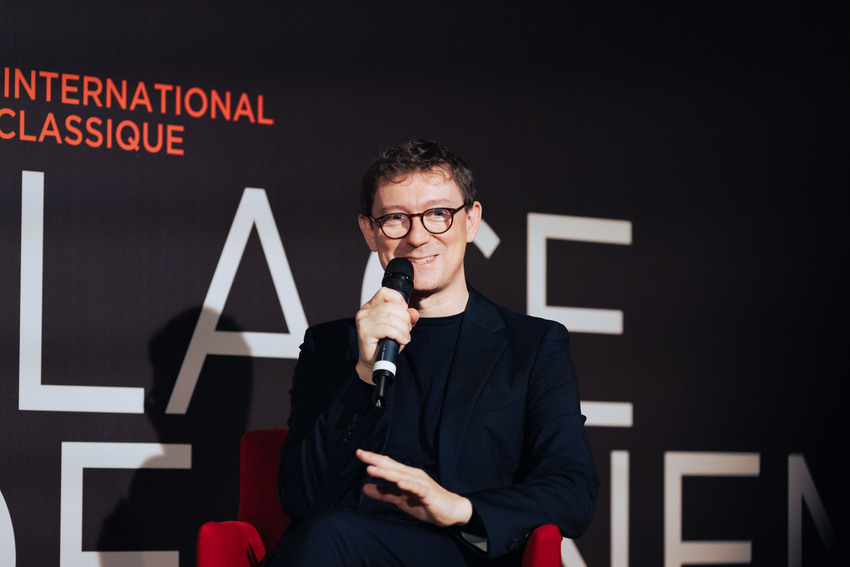
What does it ultimately mean to be here at this market?
Paolo Moretti: First of all, it’s an event for which I have great admiration, in the sense that it manages to generate a sense of excitement and a desire for classic cinema that I find extremely wholesome, necessary, and interesting. I’ve seen, once again, different generations mingling at the festival. The classic film market is a sort of natural extension, I think, of the festival's original project, which is to connect contemporary cinema with the heritage of classic cinema. The idea of bringing these two worlds into dialogue—the great auteurs of contemporary cinema with classic cinema—bears tremendous fruit. It naturally makes classic films more exciting, answering that need and desire that classic cinema should nurture in the future. This festival achieves this in an excellent way, just like L'Immagine Ritrovata in Bologna. These are two events that have managed to build a responsive formula to the desire and relevance of classic cinema in a way that is both intelligent and effective.
As a professional, cinema director, and someone involved with the Prada Foundation's cinema fund, how can a market like the classic film market be useful to you?
Paolo Moretti: Well, the truth is, we don't realize that there aren't that many of us throughout the year. Nor are there many opportunities to get together among professionals who work regularly with classic cinemas. We are a community, ultimately. Classic film markets make the existence of this community visible and allow us to identify with one another, to see that we share common questions and desires. The festival provides a space to get together, discuss things, solve problems, and come up with new ideas on how to promote heritage cinema at every level (restoration projects, Blu-ray releases, and theatrical distribution). You encounter all these profiles at the classic film market, and it’s the ideal place to spark new ideas. The market serves this exact function, bringing together an extremely defined community of people whom you might cross paths with elsewhere, but whose event is dedicated to the specific dynamics of classic film—which are very different from those of new films. It is extremely welcome and beneficial for everyone.
You wear multiple hats: cinema director, film school director, and worker for a fund like the Prada Foundation. How do these three facets communicate with one another and prove to be complementary?
Paolo Moretti: There is something that runs through all these functions: a taste for research, innovation, and novelty that we try to instill in every project. The idea is not to rest comfortably in something established that shouldn't change; it's quite the opposite: how to shake up what we are doing, how to give it momentum, push it further, and try new things? I find this deeply exciting, and it runs through all these different roles. Obviously, the dynamics are not the same, but programming at Cinéma du Grütli, programming for the Prada Foundation's cinema, the cinema funds, and even the film schools are all driven by an idea of research nurtured and cultivated in different ways. For example, there could very realistically be a single film in the future that is supported by the fund, shown at the foundation's cinemas, distributed at Cinéma du Grütli, and offered at the Lausanne school as an example of a possible career path, because it will feature something new and an element of research and contemporaneity. There is a form of shared sensibility present across all parts of the project.
Precisely as a cinema director and programmer (at the Prada Foundation, but also at Grütli), what place do you give to this heritage cinema? How do you integrate it into the programming alongside discovery and novelty?
Paolo Moretti: The word 'discovery' doesn't just apply to new films. New films necessarily respond to something from the past, one way or another, in terms of approach, subjects, or codes used. The challenge is to make classic films say something new. The films themselves aren't new, but what they can communicate to a contemporary audience—some of whom are discovering them for the first time, whether it's a 19-year-old watching a film from 1950 or 2019—remains a discovery. For someone who feels nostalgic and saw the films when they were first released, it can also represent something new, because you don't see the same things at 20 as you do at 60. Classic films always have something new to say. At Grütli, the programming varies depending on the time of year. For example, we have our two summer months where we open up completely: the programming revolved around 100 films and 100 titles during the summer. It was practically all heritage, with a few new releases and revivals from the cinematic year (about 35 titles). These were 100 heritage films screening two or three times each. In the winter, we do the same thing on a smaller scale: between December 10-15 and January 15-20, we offer our winter retrospective, usually thematic, where we treat ourselves to about fifty classic films, each with 2 or 3 screenings. During this period, the ratio is about 70 to 80% classic films and 20% other films. Some months, it reverses: in February, for example, we don't necessarily have a retrospective, but rather focuses. The percentages change a lot depending on opportunities. For instance, because of the release of The Dreamed Adventure, we just showed Valeska Grisebach's Western, which showcases her lineage. I consider this 2017 film to be a heritage film! We resist the idea of imagining that heritage is limited to black-and-white or celluloid: any occasion is a good one to bring something back to life, as long as you give it context. Showing Western "out of the blue" in the middle of a classic programming block wouldn't work. But explaining that these are the director's previous films makes it possible to articulate and create a journey. We constantly try to do this whenever we can contextualize, even though we know this is precisely where we draw the full advantage of having a small cushion of municipal subsidy funds. It allows us to say: 'Showing Western isn't going to fill the theater, but it's important to show it.' Thanks to this financial security, which doesn't force us into purely commercial considerations, we can preserve the cultural life and social fabric of the city.
In your experience, what are the main challenges facing the industry right now?
Paolo Moretti: It operates on several levels. For an exhibitor, the main challenge is knowing how to create desire, being creative in how films are presented, and not getting stuck in the idea that simply programming films is enough to bring audiences in. We are no longer in the golden age of cinema where putting up a poster was enough. It has become extremely complex and difficult. However, experience shows that you just have to dive in, taking into account all the specific parameters of each theater (geographic location, relationships with other theaters, building connections, securing public funding, working on communication). Communication has become an essential challenge: building audience loyalty is no longer done solely through physical means, but by nurturing remote relationships. We are doing more and more things remotely. This is one of the great duties for the exhibitors of the future: finding ways to make a film and a program desirable. There is no single recipe, because each theater fosters a different audience and is the heir to a unique history. There are so many different cards to play that there is no ready-made formula. Each theater needs to become aware of its real potential and specific added value in a given context, and learn how to communicate that in order to reach the audience of the future.
The International Classic Film Market is made possible by
 |
 |
 |
 |
|
In partnership with |
With the support of |





Media Partners