Spotlight on Taiwan: A Thriving Cultural Heritage
On Thursday, October 15, the International Classic Film Market welcomed Arthur Chu and Howard Yang, the Chairperson and Film Programmer of the Taiwan Film and Audiovisual Institute (TFAI), as well as Elena Lazic, Production Director at Radiance Films, and Vincent Paul-Boncour, Founder Director of Carlotta Films, for a case study moderated by Wafa Ghermani (Assistant Professor, National Central University of Taiwan) on Taiwan’s cinematic heritage.
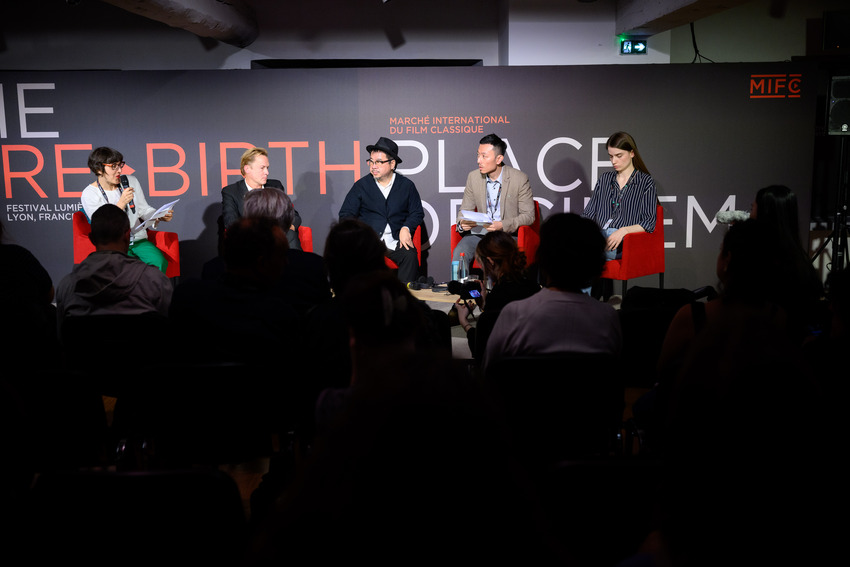
Boasting a rich New Wave movement, Taiwan’s cinematic heritage has faced numerous challenges in reviving its classic films. Its history, marked by colonization and occupation, and its multiculturalism long prevented Taiwanese classics from being screened, particularly those in the Taiwanese language, which symbolized the island’s subtle resistance to China and Mandarin.
It was in 1978, with the establishment of the Taiwan Film and Audiovisual Institute (TFAI) library, that Taiwan’s film heritage began its revival. Focusing in particular on the acquisition of international titles, the institution officially became a national archive in 1995 upon joining FIAF, the International Federation of Film Archives. Since then, the TFAI has been preserving and restoring not only Taiwanese cinema but also the island’s audiovisual and radio archives (since 2020). In total, approximately 20,000 film titles and 500,000 artifacts are preserved there in more than 20 vaults, and a digital film restoration project was launched in 2008; since then, 905 advanced digitizations have been completed and 110 titles have been digitally restored. The institution also has a library and two theaters for screening 35mm and DCP films. Guided by its mission to preserve, restore, study, and promote the works it holds and makes available to the public, the TFAI operates on an annual budget of 10.75 M€, derived primarily from government funds but also from revenue generated by its movie theaters and library.
Restoration and circulation
With regard to its restoration work, it can be commissioned in five different ways: based on the artistic or international prestige of the works, the internal needs of its programs, the TFAI’s international collaborations, its sponsors and strategic partners, or the popularity of the titles. For example, the restoration of Tracing to Expo 70’ was commissioned by the 20th Osaka Asian Film Festival in 2025, while that of The Dull-Ice Flower was requested by the public in 2023 following a survey.
As for Taiwanese copyright law, Taiwanese works enter the public domain after 50 years. Furthermore, the island’s broader history influences that of its film industry, with music rights issues complicating the proper acquisition and distribution of works.
Finally, in addition to being enjoyed on the island and in its surrounding regions, Taiwanese cinema also finds an audience in Europe, particularly thanks to the work of distributors and publishers. While many films have never been shown anywhere other than at film festivals, Radiance Films and Carlotta are working to re-release lesser-known titles from the filmographies of major Taiwanese directors in theaters or on DVD. Described as “very exciting” because it represents new opportunities, Taiwanese cinema continues to offer discoveries to publishers and distributors, who acknowledge that they often have to be patient with rights holders and producers before securing the rights to these titles. This work is facilitated, however, by the TFAI, as well as by other heritage institutions, such as The Film Foundation.
The International Classic Film Market is made possible by
 |
 |
 |
 |
|
In partnership with |
With the support of |





Media Partners