What is the economic impact of heritage on the European audiovisual industry?
Long regarded as a simple cultural niche or an object of cinephile veneration, heritage cinema nevertheless carries significant weight in the audiovisual ecosystem. This was the finding of the roundtable discussion titled "What is the economic impact of heritage on the European audiovisual industry?", moderated by Chiara Zappalà (Creative Europe MEDIA Officer at Relais Culture Europe).
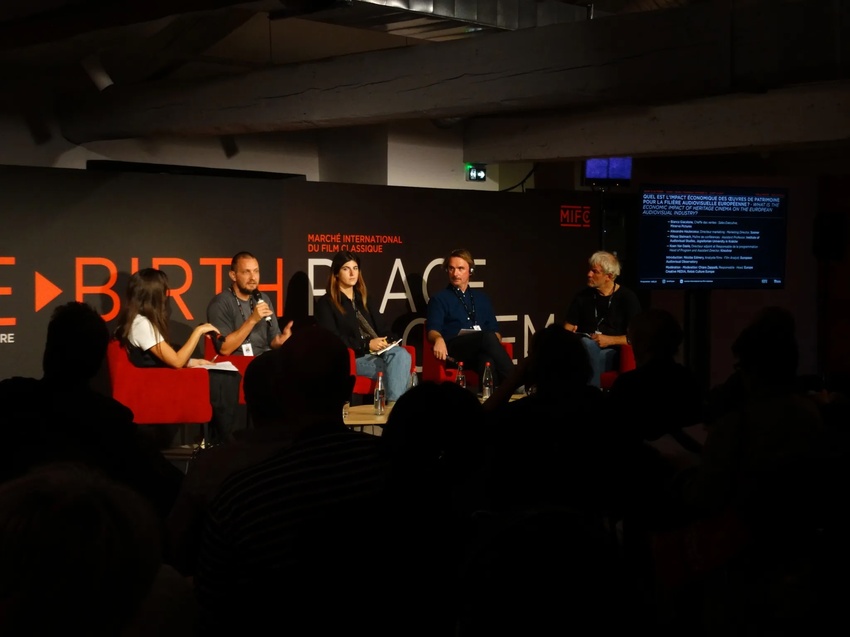
Bringing together several industry experts, the discussion explored the entire value chain with Nicolas Edmery (Film Analyst at the European Audiovisual Observatory), who delivered the statistical introduction, Miłosz Stelmach (Lecturer at the Institute of Audiovisual Studies at the Jagiellonian University in Kraków and organizer of the Timeless Film Festival Warsaw), Bianca Giacalone (Head of Sales at Minerva Pictures), Alexandre Hautecoeur (Marketing Director of the Sooner platform), and Koen Van Daele (Deputy Director and Head of Programming at the Kinodvor cinema in Ljubljana).
While the European Audiovisual Observatory points out that heritage works still capture only about 1% to 1.5% of theatrical admissions, this statistic masks an economic reality undergoing rapid transformation. By following value across the entire chain—from technical restoration to new streaming uses—heritage reveals its true nature: that of a strategic investment and a buffer for the industry.
A Value Chain Reinvented by Digital Technology
The vitality of the sector is measured first and foremost within the twists and turns of modern distribution. Far from cannibalizing the market, the multiplicity of digital windows breathes a second youth into catalogs.
For players like Minerva Pictures, which manages thousands of titles, exploitation now relies on extremely fine editorial engineering. New distribution models—whether SVOD thematic channels or the meteoric rise of FAST (Free Ad-supported Streaming TV) channels—make it possible to fragment offerings to target niche communities passionate about specific genres or eras.
On generalist subscription platforms such as Sooner, the figures shatter received wisdom: heritage cinema is not merely the domain of an aging audience. It massively attracts younger generations (particularly 18–24 year-olds) and above all constitutes a powerful acquisition and retention lever. A well-showcased classic becomes an exclusive title, an identity marker for a platform seeking to stand out in the ocean of contemporary overproduction.
The Challenge of Visibility and the Blind Spots of the Heritage Economy
Yet, having a rich catalog is no longer enough. In a saturated landscape where fifteen new releases can drop on the very same day, the mere availability of a work generates zero viewership.
The true cost of heritage today is a marketing and editorial cost. Rehabilitating a classic requires recreating context, forging partnerships with content creators, video makers, and influencers, and redeploying critical storytelling.
Added to this are structural challenges that are frequently glossed over:
- Invisible costs: Digital or analog preservation involves heavy infrastructure, energy-guzzling servers, and growing ecological and logistical constraints.
- The coordination headache: Between film archives with unequal resources, national archives, and fragmented rights holders, the lack of seamless centralization for metadata and available materials (such as subtitles) remains a major barrier to optimal cross-border circulation.
Between Cultural Requirement and Profitability: The Model of Theaters and Shared Risk
At the heart of the ecosystem, theatrical exhibition plays a pivotal role. In territories with a restricted language or market, such as the Kinodvor cinema in Ljubljana, programming heritage is a deeply political and identity-driven choice. These screenings do not aim for immediate box office profitability; they enrich the theater's image, build audience trust, and strengthen the foundation of art-house cinema.
However, this dynamic of preservation and redistribution cannot rely solely on the goodwill of independent exhibitors. While public subsidies for restoration remain heterogeneous across countries, a hybrid model is emerging, driven by private investment from distributors (particularly British, German, or American) who partner with rights holders to finance heavy 4K restorations.
Toward a New Golden Age?
Ultimately, heritage cinema does not survive on the margins of the industry: it nourishes it. Whether fueling platform streams, stimulating the creativity of post-production companies through the demanding art of restoration, or re-enchanting the collective theatrical experience, the classics of our visual memory serve as a safe bet.
For this economic and cultural promise to be fully realized on a European scale, the entire challenge now lies in the ability of institutions, archives (such as FIAF or networks of cinematheques), and economic stakeholders to break down silos between their expertise and structure a genuine common repertoire policy.
The International Classic Film Market is made possible by
 |
 |
 |
 |
|
In partnership with |
With the support of |





Media Partners